
Scoliosis is a condition that is easy to define but extremely challenging to treat, as no two cases are alike and the spine can become difficult to manage and control. It is important to mention that there is no cure. Scoliosis is a curvature of the spine, an abnormality which can curve into an “S” or a “C” shape.
It can affect anyone at any age although most predominantly affects women and children. While Scoliosis does start off at a mild curvature, it can grow to a more severe curve if left untreated. The curve can grow so bad as to push on some organs such as your lungs…making it hard to breathe.
Scoliosis typically causes the spine to twist, leading to one side of the ribs and muscles protruding further than the other. While the causes are yet to be known…we do know that heredity is a factor as well as neuromuscular conditions, birth conditions, change in cell structure and surgery as a baby.
You will NEVER see two Scoliosis cases alike. Some symptoms you may see:
- Uneven shoulders and hips
- Rib cage protruding
- Change in posture
- Back pain
- In severe cases, you’ll see a very curved spine
- Clothes not fitting properly
Again Scoliosis cannot be cured, but there are ways to manage it, prevent its progression, and provide you or your loved ones a more comfortable way of living.
Treatments can range anywhere from physical therapy, wearing a corrective brace, or a more invasive approach as to having spinal fusion surgery. The way the Doctor will approach your case will depend on your curve, pain, and the rate your curve is moving at. And if you feel more comfortable getting a second option and go to another Doctor, DO IT.
Scoliosis doesn’t just affect your spine…it affects your entire body.
- Your arms will hang at different lengths
- Cardiovascular complications
- Muscular imbalance
- Constipation
- Acid reflux
- Decreased lung function
It is important to always get checked out because it is a serious curve of the spine that affects your entire system. And I must also note that there are a few different types of Scoliosis:
- Idiopathic – is a curve with an unknown cause. The most common one.
- Congenital – A rare spine abnormality found at birth
- Neuromuscular – Abnormalities in the muscles and nerves that support your spine. It usually happens alongside neurological (nerve) or muscular conditions like, cerebral palsy, spina bifida.
According to the Scoliosis Research Foundation as of 2024, there are about 7 million people, about 2% – 3% of Americans, that have a form of Scoliosis. While there isn’t a cure, there are always some form of medical advances made towards a way to make it easier for patients to correct a curve. We obviously have to create awareness for Scoliosis otherwise how are these medical marvels supposed to know what the typical pain is, or that mostly everyone has a protruding shoulder blade?
I have a double curve and am kind of tired of having spine surgeries(just had one). My Scoliosis is pretty severe and doing my best to cope with it.
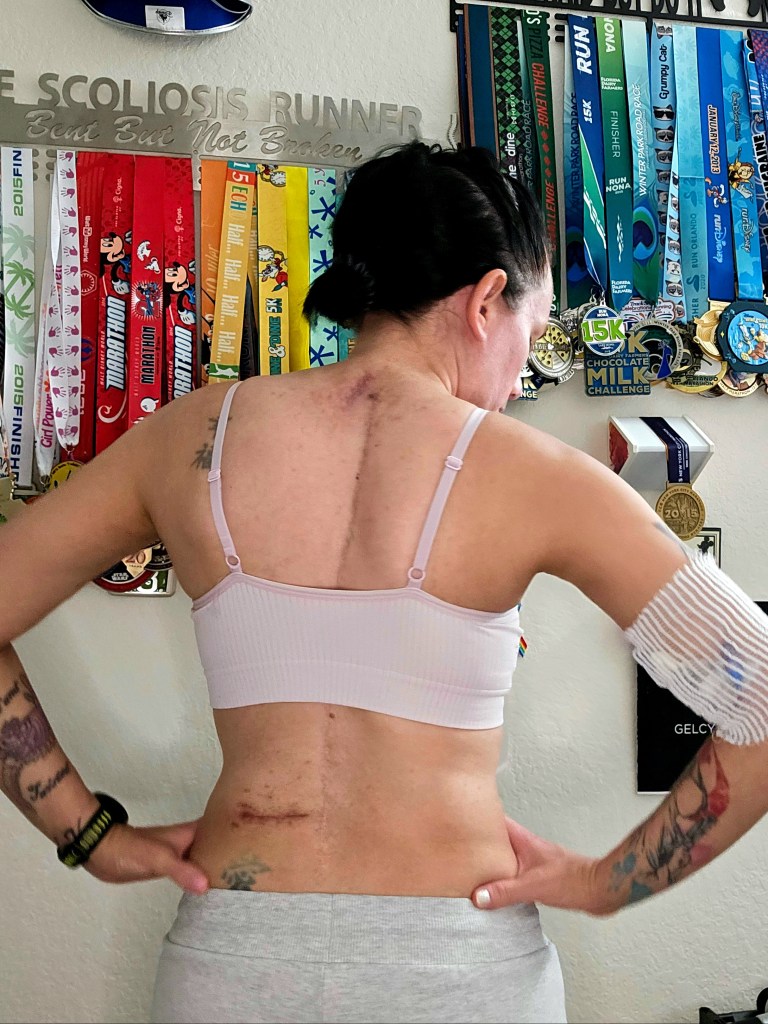
Hi, this is my very twisted spine. You can see my shoulder blade protruding.
Big ups to my fellow Scoliosis warriors! It’s hard to breathe but we got this!
-g

 Empire Unleashed
Leave a comment